The Billion-Dollar Question Every Modernizing Airport Should Be Asking
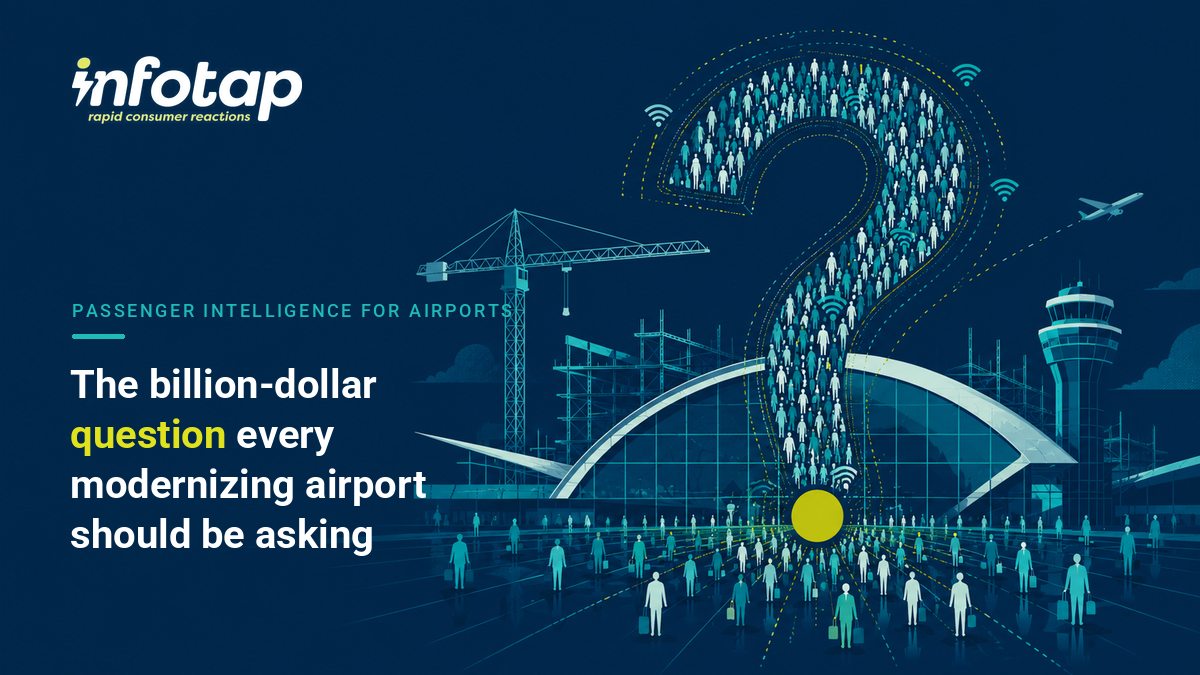
Across the United States, airports are in the middle of the largest wave of terminal modernization in a generation. Cleveland Hopkins is advancing its $1.6 billion CLEvolution program. Pittsburgh opened an entirely new terminal. Kansas City did the same. Salt Lake City, LaGuardia, and dozens of mid-size airports are somewhere on the journey between groundbreaking and ribbon cutting.
Every one of these programs makes the same promise: a better experience for the passenger.
Which raises a question that is surprisingly hard to answer with traditional tools. While the cranes are up, the walkways are rerouted, and the checkpoints are shifting, how does an airport actually know what passengers think?
The measurement gap in the middle of transformation
Most airports measure passenger experience the way they did fifteen years ago. A quarterly survey program. Manual intercept interviews, administered on tablets by airport staff who can only reach a handful of passengers per hour. An email survey sent days after the trip, answered by 2 to 5 percent of recipients, skewed toward the angriest and the happiest travelers.
That approach has always had problems. During a multi-year construction program, it breaks down completely:
- The terminal changes faster than the survey cycle. A checkpoint reconfiguration or a new wayfinding scheme can go live on a Tuesday. Quarterly data cannot tell you whether it worked until months later.
- Small samples cannot isolate what changed. If satisfaction dips, was it the construction noise near Concourse B, the relocated drop-off, or something else entirely? A few hundred responses per quarter cannot say.
- Leadership needs evidence now, not next quarter. Boards, airline partners, and city stakeholders funding a billion-dollar program want to see that passenger experience is holding up through every phase. Anecdotes are not evidence.
The airports getting this right have flipped the model. Instead of chasing passengers after the trip, they meet them at the one moment nearly every traveler shares: connecting to airport Wi-Fi.
What real-time passenger intelligence looks like
At Cincinnati/Northern Kentucky International Airport (CVG), passengers who connect to the airport's guest Wi-Fi are forwarded, after authentication, to a short gamified Infotap survey. They are already online. There is no app to download, no email address to surrender, and no condition attached to their connectivity. They answer 3 to 5 questions and get on with their day.
The results have redefined what a "good" response rate means in aviation research:
- 22,000 completed surveys every month, from one airport
- 76 percent completion rate among passengers who start a survey
- Roughly 40 percent of all Wi-Fi-connected passengers complete a full survey
- 28-second median completion time
- A running average experience score of 4.29 out of 5, trackable by concourse, gate area, and shift
Compare that to the 2 to 5 percent response rates typical of post-trip email surveys, and the difference is not incremental. It is a different category of instrument. At this volume, an airport can see satisfaction move in near real time, segment it by concourse or time of day, and know within days whether a change helped or hurt.
"In real-time, we're gaining valuable insights into traveler profiles and their experiences as they navigate our airport and explore the amenities we offer. This empowers us to make data-driven decisions and shape a future of personalized services for our travelers."
Brian Cobb, Chief Innovation Officer, CVG International Airport
From raw responses to executive answers, automatically
Volume alone is not the point. Nobody on an airport leadership team wants 22,000 more rows in a spreadsheet.
This is where AI analysis changes the economics of passenger research. When CVG wanted to understand passenger readiness for Advanced Air Mobility (AAM), the study collected 3,284 valid responses with a margin of error of plus or minus 1.71 percent. Infotap's AI engine then produced a publication-ready executive report: cross-tabulations, completion funnels, sentiment analysis of open-ended responses, and prioritized recommendations. The headline finding, that 65.7 percent of travelers had zero prior awareness of AAM and that familiarity strongly predicted willingness to fly, arrived as a strategic narrative, not a data dump.
The same engine synthesized CVG's survey data with airline and demographic signals to generate six distinct traveler personas, from the schedule-driven Frequent Flyer to the price-sensitive Leisure Explorer. Those personas now inform food and beverage, retail, and marketing strategy across the terminal.
The practical implication for a modernizing airport: any question leadership can phrase, the passenger base can answer, at statistical scale, with analysis delivered in hours. Should the new checkpoint signage be tested before rollout? Ask this week's passengers. Is perception of wait times holding steady through a construction phase? Track it shift by shift. Will travelers use a new amenity planned for the future terminal? Measure demand before pouring concrete.
Why this matters most during modernization
A terminal program is a decade of decisions, and most of them are made on behalf of a passenger who is not in the room. Continuous, high-volume passenger intelligence puts that passenger in the room:
- Baseline before construction. Establish satisfaction benchmarks by concourse and touchpoint so every phase can be measured against a real starting point.
- Monitor during disruption. Detect experience degradation early, at specific locations, and course-correct in-shift rather than in the next fiscal year.
- Validate after each phase opens. Show boards, airline partners, and the community hard evidence that the investment is delivering, with sample sizes that survive scrutiny.
- Design the future terminal with data. Test concepts, amenities, and technologies with the actual passenger mix rather than industry averages.
And because the deployment rides on infrastructure the airport already owns, there is nothing to build. If the existing captive portal supports a redirect URL, the platform works. CVG went from concept to live passenger intelligence without new hardware, new apps, or new staff.
The question worth asking
If your airport is investing hundreds of millions, or billions, in the promise of a better passenger experience, the measurement plan deserves the same ambition as the construction plan. The passengers walking through your terminal today are the most valuable focus group your program will ever have. They are already connected to your Wi-Fi.
The only question is whether you are asking them anything.
Read the full CVG case study or book a demo tailored to your airport to see what continuous passenger intelligence would look like on your network.